Paul ran an intensive workshop aimed specifically at music students last week. We had a great turn out with several experienced players supporting the session.
More details are here, including links to resources: Music student workshop November 2025
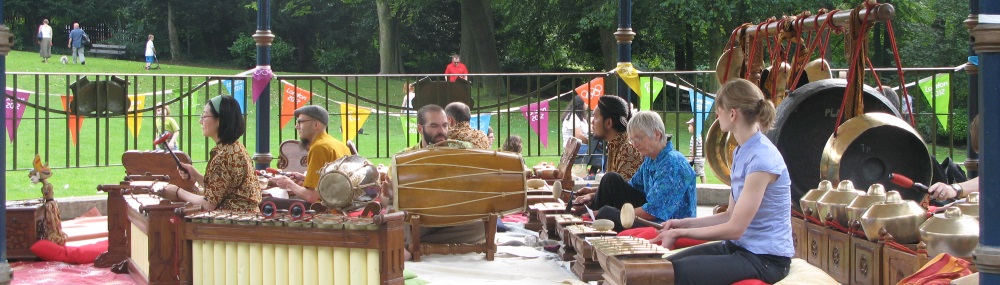
Paul ran an intensive workshop aimed specifically at music students last week. We had a great turn out with several experienced players supporting the session.
More details are here, including links to resources: Music student workshop November 2025
Some basic info is on the Resources page, including the names of the instruments, the colotomic structure diagrams of some of the forms etc. This also includes mp3 files of our tuning – note that not all gamelans are tuned the same way, with variations in the intervals between the notes and in the absolute pitch of a 6.
We started with a very simple Sundanese style piece using the slendro five note scale. Sunda is the Western part of the island of Java. We learned this by ear and gained an understanding of the colotomic structure of the music – gong cycles, broken up by the other punctuating instruments. On top of this comes the balungan – often translated as basic melody but literally “skeleton”. We then added in multiple levels of elaboration of the balungan.
The notation for this piece is written out the same way we learned it – starting with the gong note, adding in the half way note and then continuing to subdivide. Once we were repeating the cycle, Egidija started using the second biggest gong at the end of three cycles then the largest at the end of the fourth. The kenong can play 3 instead of 1 – we didn’t do that.
In the grid version of the notation, kendang refers to the drum, and kecrek is a rattly instrument that we don’t have.
This is a central Javanese piece in a fast and loud style, using the seven note pelog scale. The notation is here: Lancaran Tropongan.
It is quite unusual in that it uses all seven notes of the scale, but it is still based on a five note subscale: 1, 2, 3, 5, 6. The 7 and 4 are just used as passing notes – they are a bit like accidentals in western music in this piece. Other pelog pieces can be based on 2, 3, 5, 6, 7 and occasionally 1, 2, 4, 5, 6. 4 is very rarely used in important places in the music.
The main balungan part that most people played is at the bottom of the page. This is also what the bonang and gong players used to work out their parts. The faster line is an elaboration played by the sarons which we had a go at towards the end.
At the end of each bar (gatra in Javanese) the kettle gong (kenong) plays. These are the strong notes. Each line (gong cycle) can be thought of as having two halves, which make up a questioning and answering phrase. The kenong reinforces this by playing the half way note throughout the first phrase, and the final note throughout the second phrase.
The kempul (smaller hanging gongs) come half way between kenong strokes (but miss the one after the gong). There is a choice of which note to play – the simplest approach is just to play 5 throughout, but the player has freedom to use other notes that fit with the balungan line – as long as they play in the right places and don’t push the boundaries too far.
Ketuk and bonangs play in the weak points of the bar, on the 1 and 3 – between the balungan notes. Bonangs play the last note of the bar (the strong note) and so are anticipating this. A sense of tension and resolution comes from the different instruments coming together at the important places – end of piece, end of line, end of bar – while they may be playing several different notes at other times.
There is a full score of a different Lancaran here: bendrongan-score. This includes the drum part and you can also see the smallest metallphone (peking) repeating the notes.
This is a slower, more refined piece. We played it at two tempi – firstly with two pulse beats between the melody notes, then with four. We then used this to look at the different ways each instrument elaborates the melody.
The basic notation is here: Parawisata notation. There is a recording of the Durham group playing the piece here Parawisata MP3. You can hear all the elaborating instruments. A description of how the ornamentation works is here ornamentation. The bonangs are playing “mipil”.
There is a video of the piece here: https://www.youtube.com/watch?v=xB8HgpMCe2E. This includes the male chorus and female singers. You’ll notice the bonangs switch to an interlocking style of ornamentation some of the time. You can see and hear some of the soft instruments that we didn’t play, in particular the gender, played with both hands, next to the singers.
Another video here https://www.youtube.com/watch?v=welDcST8uJY includes the rebab (bowed lute), suling (bamboo flute), siter (zither) and the gambang (wooden xylophone) is very audible although I can’t spot it on camera.
We had a lot of interest at this year’s freshers’ fair and its been good to welcome new players sitting alongside those who have been in the group for a while – in some cases a long while.
Do come along, see and hear and play our beautiful instruments and see what we get up to on Wednesday afternoons.
We’ve had a few sessions now and a mix of new players and some of those who have been around for a while. We still remain open to all – no experience of any sort of music required, just come along and have a go. We are at Elvet Hill House (see the find us page) every week between 2 and 5pm.
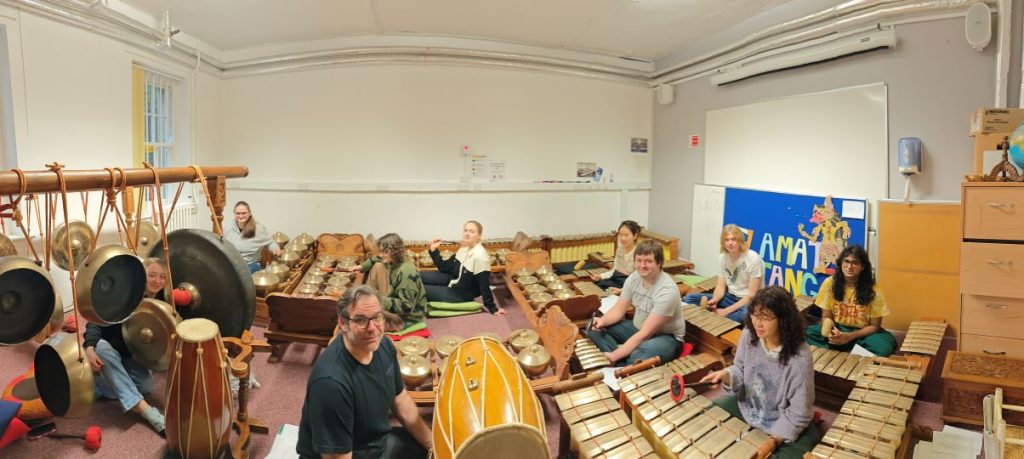
Come and join us on Wednesday afternoons in Elvet Hill House.
We are very near to Van Mildert College and the Oriental Museum: Find Us
It is cosy but we have most of the instruments set out with both tunings available.
First session of 2024/25 will be on 9th October. We’ll be there from 2-5pm, you can come at any time and stay for as long or short a time as you like. No experience required!
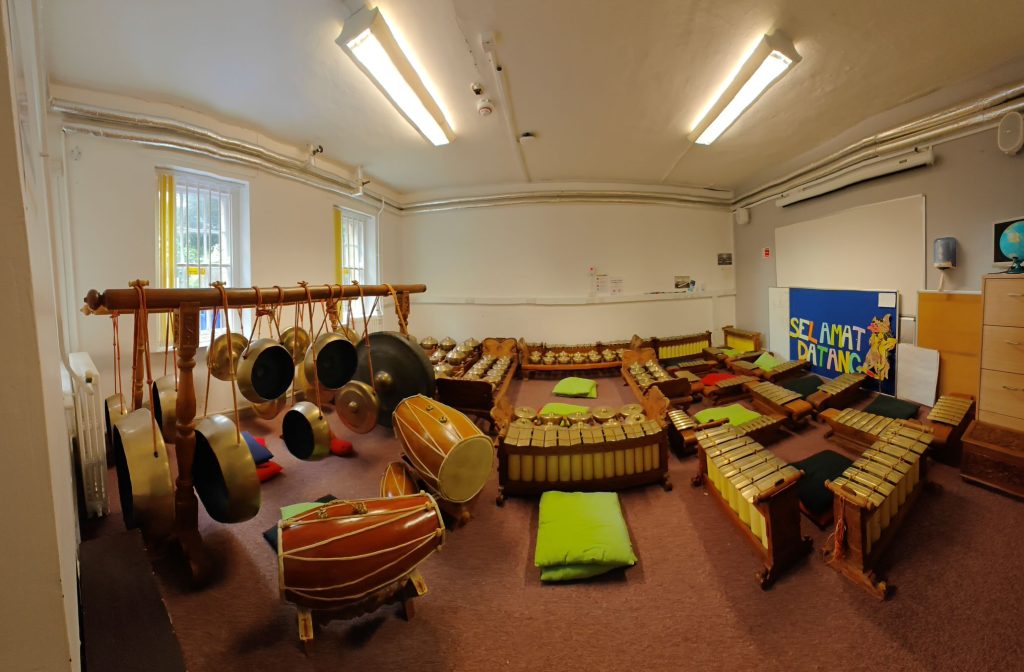
Last year was a very successful one, although nothing got added to the website – culminating in a performance / workshop event in June.
In good news we have the building for another year at least so we will see you all – sessions restart on 4th October.
During summer 2022 we were told we had to move again. Although we are now less central, we have a very pleasant space with good facilities. We are meeting regularly again, every Weds 2-5pm. Lots of new players in the group so we are having a good time – but there is still room for more so come along if you can.
We had fifteen players at various points during the afternoon in our first session of November. Many new people quickly getting the hang of what to do and it is sounding good!
The resources page has been updated with a list of the pieces we are planning to work on this year, so take a look to find out more about what we are doing and for notation / video clips.
Numbers were fine last week and so we will return to our traditional approach: there is no need to book a slot, it is fine to just come along any time between 2pm and 5pm on future Wednesdays. If we do get a lot of people we can always make use of our second room. Hope to see you there.